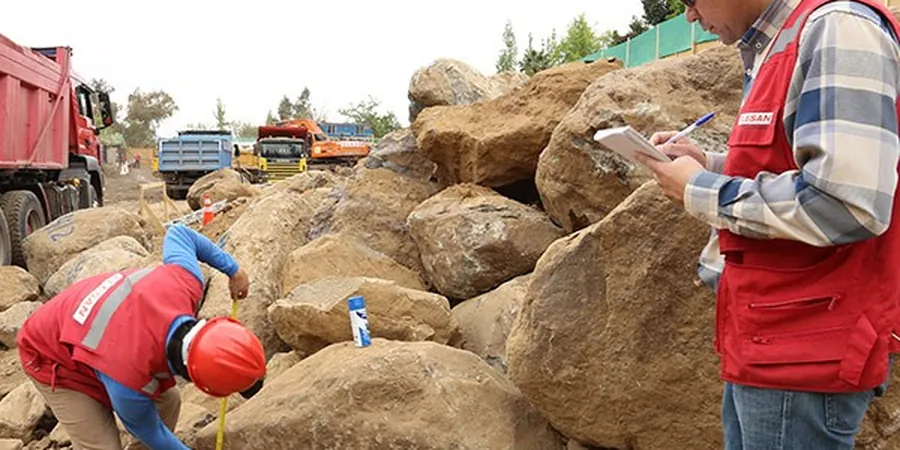
The first thing that arrives on a Northampton site is usually the tracked drilling rig — a compact Comacchio or Dando Terrier that fits through tight Victorian terraces without drama. It sets up over a pre-cleared borehole location, and within minutes the rotary core barrel is cutting into weathered Northampton Sand Formation ironstone, the same ferruginous geology that built this town's historic iron industry. Samples come up in clear plastic liners, logged immediately for colour change, fracture spacing, and moisture content by a geotechnical engineer who knows the local sequence. The rig's SPT hammer drops 63.5 kg through 760 mm, and the blow counts tell you within the first three metres whether you're dealing with competent sandstone or a soft pocket of Whitby Mudstone — critical information in a borough where the bedrock can vary from RQD 80% to completely weathered within a single housing plot. These recovered cores and disturbed samples are then sealed, chained to custody forms, and driven to our UKAS-accredited laboratory for the full Atterberg limits and triaxial testing programme that Eurocode 7 demands for Category 2 structures.
In Northampton's layered Jurassic geology, effective stress parameters from a CU triaxial test can change a foundation design from a conservative 2.5 m wide strip to a lean 1.2 m — and that's the difference a soil mechanics study makes.
Process overview
Local context
A four-storey apartment block near St James Mill Road hit unexpected ground during piling. The borehole logs had identified competent Northampton Sand at 4.5 m depth, but a buried paleochannel — an old Nene river meander filled with soft organic silt — was missed between boreholes spaced at 25 m centres. Four CFA piles settled differentially during load testing, exceeding the 10 mm settlement criterion in the ICE Specification for Piling. The investigation had followed BS 5930 minimum guidance, but the site's fluvial complexity demanded tighter spacing and supplementary MASW geophysics to map the channel edge. This is a textbook Northampton problem: the town sits at the confluence of two river systems, and the Quaternary geology is a patchwork of terrace gravels, alluvium, and head deposits that shift laterally over tens of metres. A soil mechanics study that only looks vertically — one borehole, one set of lab tests — can miss the horizontal variability that governs differential settlement. Our approach layers borehole recovery data with particle size distribution and consolidation testing to build a 3D ground model, not just a log.
Relevant standards
BS 5930:2015+A1:2020 — Code of practice for ground investigations, BS EN 1997-1:2004 (Eurocode 7) — Geotechnical design, BS 1377-7:1990 — Shear strength tests (triaxial), ISO 17892-9:2018 — Consolidated triaxial compression on water-saturated soils, NHBC Standards 2024 — Chapter 4.2: Building near trees
Additional services
Advanced Triaxial and Consolidation Testing
CU and CD triaxial tests with pore pressure measurement on 38 mm and 50 mm specimens, plus one-dimensional oedometer consolidation to determine mv and cv. Essential for assessing settlement of the Lias Clay and Whitby Mudstone formations that underlie much of Northampton's southern expansion areas.
Integrated Site Characterisation Package
Combines rotary core drilling with in-situ SPT, shear vane testing in alluvium, and laboratory particle size distribution by wet sieving and hydrometer. Delivers a full geotechnical interpretive report with characteristic values for bearing capacity and pile skin friction per EC7.
Typical parameters
Top questions
How long does a full soil mechanics study take for a typical Northampton residential plot?
Site work usually takes one to two days for a single borehole with SPTs at 1.5 m intervals. The laboratory programme — classification, Atterberg limits, and a set of triaxial or shear box tests — typically runs 10 to 14 working days from sample receipt. The interpretive report follows within a week, so plan on four to five weeks from instruction to final deliverable for a standard single-dwelling investigation.
Do I need a soil mechanics study for a rear extension, or is a simple trial pit enough?
Under Part A of the Building Regulations and BS 8103-1, a single-storey extension on competent ground may only require a trial pit with visual logging. However, if the site is within 30 m of mature trees on shrinkable clay — common in Northampton's Lias Clay zones — or if the extension imposes concentrated loads, then a soil mechanics study with plasticity index and desiccation assessment is strongly recommended to satisfy NHBC or local authority building control.
What does a soil mechanics study cost for a Northampton commercial project?
For a commercial development requiring two to three boreholes, full laboratory classification, and strength testing with an interpretive report, the cost typically ranges from £2,470 to £4,060 depending on access constraints, depth of investigation, and the number of triaxial or consolidation tests specified. Sites with difficult access or requiring traffic management in central Northampton will be at the upper end.
How do you handle the Northampton Sand Formation's variability in your lab programme?
The Northampton Sand can transition from a weak rock to a dense granular soil across short distances. We address this by visually classifying every core run, then running point load tests on intact rock pieces alongside particle density and water absorption measurements. Where the material is fully weathered to sand, we run direct shear or large triaxial tests on reconstituted specimens compacted to in-situ density. The lab programme adapts to what the core actually shows — we do not apply a fixed test menu regardless of geology.