Northampton’s expansion from a Saxon settlement into a major Midlands town has left a layered geological footprint beneath its streets. The river terraces of the Nene, with their sands and gravels, sit uncomfortably close to the weathered ironstone of the Northampton Sand Formation, creating abrupt changes in soil behavior over short distances. A reliable grain size analysis therefore becomes the first practical step in any geotechnical desk study here. By quantifying the distribution from coarse sands down to colloidal silts using both sieve stacks and hydrometer sedimentation, the lab data directly feeds into bearing capacity estimates and drainage models. For sites near the Brackmills industrial estate, where made ground overlies natural strata, we often combine this testing with in-situ permeability measurements to validate earthworks specifications. The resulting particle size curves are interpreted against BS 5930:2015 classifications, ensuring that engineers working on everything from residential footings to warehouse slabs get reproducible numbers rather than subjective field descriptions.
A single hydrometer reading misjudged by one degree of temperature can shift your clay fraction by three percent, enough to change the soil classification from silty sand to sandy silt.
Process overview
Local context
The Northamptonshire climate adds a seasonal twist to grain size work. Persistent autumn rainfall saturates the upper weathered zone of the Northampton Sand, mobilizing fines and creating temporary perched water tables that can wash out excavation bases overnight. A soil that grades cleanly as a poorly graded sand in summer may, by late October, carry enough silt to behave as a frost-susceptible layer under lightly loaded pavements. This variability means that a single bulk sample taken from a trial pit in wet weather may not represent the formation’s true particle size envelope. The design risk compounds when engineers assume uniform permeability from a sieve curve alone, overlooking the clay-sized fraction that governs long-term settlement. On slopes overlooking the Nene floodplain, fine-grained colluvium further complicates the picture, demanding careful laboratory dispersion to avoid overestimating sand content and underestimating the potential for creep movement.
Relevant standards
BS 1377-2:1990 – Classification tests, BS 5930:2015 + A1:2020 – Code of practice for ground investigations, BS EN ISO 14688-1:2018 – Identification and classification of soil, BS ISO 3310-1:2016 – Test sieves, technical requirements
Additional services
Sieve Analysis (Coarse Fraction)
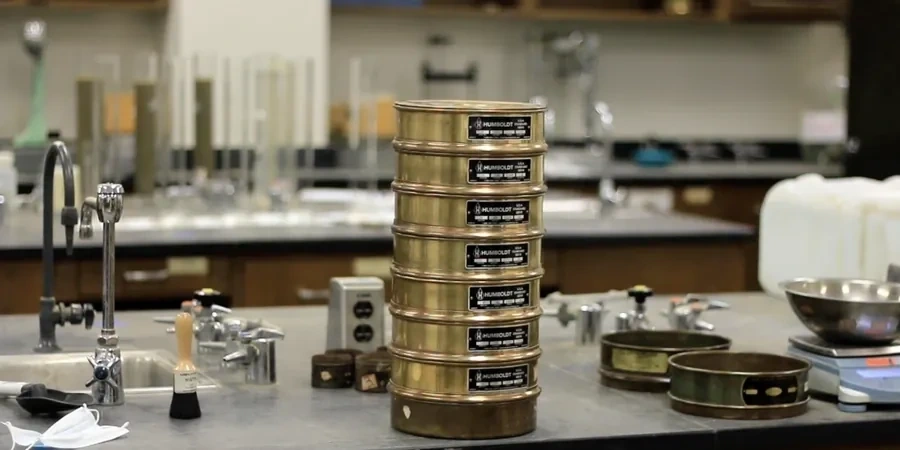
Mechanical sieving of the material retained on the 63 µm sieve, using a full stack from 75 mm down to 63 µm. The procedure yields the gravel and sand distribution curves essential for assessing compaction characteristics of the Nene Valley terrace gravels. All retained masses are weighed to 0.1 g resolution, and the fineness modulus is calculated where required for concrete aggregate compliance.
Hydrometer Sedimentation Analysis (Fine Fraction)
Density-based measurement of silt and clay fractions below 63 µm using a BS 152 hydrometer. This test is critical for the weathered ironstone soils of Northampton, where the clay content directly influences plasticity, shrink-swell potential, and the long-term drainage behaviour of sustainable urban drainage systems (SuDS). Temperature corrections are applied at each reading interval over a 24-hour sedimentation period.
Typical parameters
Top questions
What sample mass is required for a combined sieve and hydrometer test on Northampton ironstone soil?
For a combined analysis, we typically ask for around 1.5 kg of dry material passing a 20 mm sieve. The coarse portion goes through the full sieve stack, while a representative 50 g sub-sample of the minus 425 µm fraction is used for the hydrometer sedimentation. If the soil is heavily iron-cemented, a larger initial mass may be needed to ensure enough fine material after disaggregation.
How does the hydrometer method account for temperature variations in the lab?
The hydrometer is calibrated at 20°C, and a temperature correction factor is applied to every reading taken from the sedimentation cylinder. The cylinder itself sits in a water bath maintained at a constant temperature, usually within ±0.5°C. This correction is critical because a shift of a few degrees changes the fluid density and viscosity enough to alter the calculated particle diameter by a measurable margin.
What is the typical cost for a full particle size distribution test in Northampton?
A full analysis covering both sieve and hydrometer stages generally falls between £80 and £170, depending on the number of sieve sizes requested and whether pre-treatment for organic content or carbonate removal is needed. Soils with a high proportion of ironstone fines sometimes require longer dispersion times, which can place the cost at the upper end of that range.
How do you classify a soil that shows a gap-graded curve in the Northampton Sand Formation?
Gap-graded curves are surprisingly common in the weathered ironstone, where the decomposition of iron cement releases fine sand while leaving behind clay-sized oxides. We apply the BS 5930 descriptive framework, noting the missing intermediate fractions and calculating both the coefficient of curvature (Cc) and the uniformity coefficient (Cu). The final classification might read as a sandy gravelly clay or a silty sand with gravel, depending on the proportions, and we flag the gap-graded nature for the design engineer because it affects both permeability and compaction behaviour.