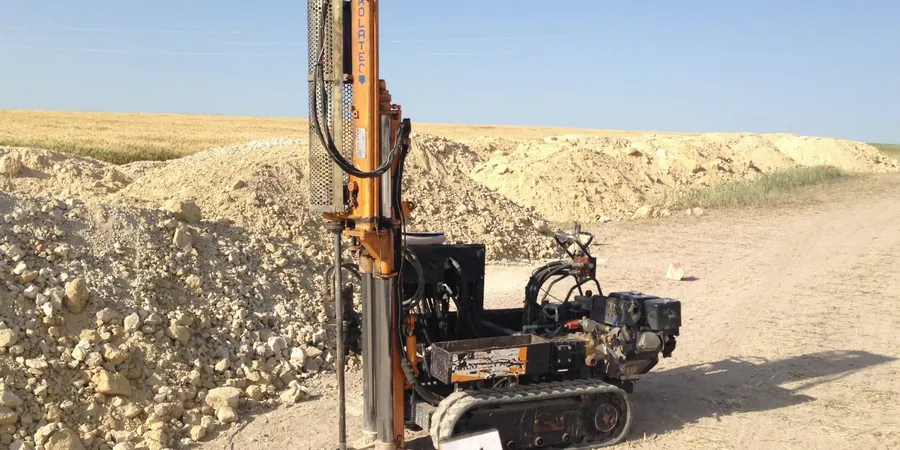
The wireline winch lowers the double-packer assembly into the borehole with a steady hum. In Northampton, field permeability testing starts with the hardware — a calibrated pressure gauge, graduated flow meter, and the packer system isolating the test interval. The Lefranc method suits the weathered Northampton Sand Formation, where variable ironstone layers create unpredictable seepage paths. For deeper investigations into the underlying Charmouth Mudstone, the Lugeon test applies sustained pressure stages to measure rock mass conductivity. The equipment gets muddy fast on sites near the River Nene floodplain. We run pre-test calibration checks on every gauge before the first water volume is recorded, because the difference between a laminar flow reading and a fractured-rock hydraulic jacking signature often comes down to instrument precision. SPT drilling provides the borehole, but the permeability test reveals how water actually moves through the formation — a parameter no disturbed sample can give you with confidence in these variable Jurassic strata.
A 10-metre borehole in Northampton's Jurassic sequence can yield permeability values differing by three orders of magnitude between the sand and the mudstone.
Process overview
Local context
Northampton sits at roughly 90 metres above Ordnance Datum on its higher ground, dropping to below 60 metres along the Nene floodplain. That 30-metre difference drives the groundwater gradient through the Northampton Sand aquifer. What catches out inexperienced ground investigators is the perched water tables within the ironstone — isolated saturated lenses sitting well above the regional water table, created by clay partings and variable cementation. A site investigation that only logs the strike water level at borehole completion misses these perched zones entirely. The consequence shows up during excavation: a cut that looked dry on paper suddenly weeps from a thin sandy band at 3 metres depth. The Lefranc test, run at discrete intervals as the borehole advances, identifies these perched horizons before they become a construction problem. In the Charmouth Mudstone, the risk shifts from high permeability to extremely low — but with fracture flow in the weathered zone. Lugeon testing here distinguishes between intact claystone (k < 10⁻⁸ m/s) and fractured zones where water moves preferentially. For basement excavations in the town centre, deep excavation dewatering design depends entirely on this fracture-flow characterisation.
Visual overview
Relevant standards
BS 5930:2015+A1:2020 – Code of practice for ground investigations, BS EN 1997-2:2007 – Eurocode 7: Ground investigation and testing, BS EN ISO 22282-2:2012 – Geotechnical investigation and testing – Geohydraulic testing – Part 2: Water permeability tests in a borehole using open systems
Additional services
Lefranc Constant-Head Test
Suited to the Northampton Sand Formation and granular river terrace deposits. A maintained water level feeds the test section while flow rate is recorded. We run checks for filter cake effects and adjust for borehole geometry per BS 5930 Annex C.
Lefranc Falling-Head Test
Applied in lower-permeability horizons such as weathered mudstone or silty lenses within the sand. Water level decay is monitored with a pressure transducer, giving a clean k-value without the need for sustained pumping.
Lugeon Multi-Stage Test
Designed for fractured Charmouth Mudstone and limestone bands. Five pressure stages expose flow regime behaviour — laminar, turbulent, dilation, washout, or jacking — reported with Lugeon values and flow regime classification per Houlsby interpretation.
Combined Permeability Profiling
A sequence of Lefranc tests at 2–3 metre depth intervals within a single borehole. Ideal for sites where perched water tables are suspected, this approach maps vertical permeability variation across the Northampton Sand before excavation or piling decisions are finalised.
Typical parameters
Top questions
What is the difference between Lefranc and Lugeon permeability tests?
Lefranc tests measure hydraulic conductivity in soils and weak, non-fractured rock using a single open section of borehole, normally with a constant or falling head. Lugeon tests are designed for fractured rock — they use a double packer to isolate a section and apply stepped pressure stages to identify flow regime changes. In Northampton, we typically use Lefranc in the Northampton Sand Formation and Lugeon in the fissured Charmouth Mudstone or limestone bands.
When is a field permeability test required instead of a laboratory permeability test?
Laboratory tests on small samples cannot capture fracture flow, macropores, or the true fabric of the ground. In Northampton's Jurassic strata, ironstone jointing and mudstone fissuring control mass permeability. BS 5930 and Eurocode 7 both specify In-Situ where groundwater control is critical — for example, basement excavations, cut slopes, or landfill liner assessments. A lab permeameter simply cannot reproduce the field-scale flow paths.
How much does a Lefranc or Lugeon permeability test cost in Northampton?
A single Lefranc or Lugeon test in a Northampton borehole typically falls between £520 and £880, depending on depth, access conditions, and whether it is part of a wider ground investigation programme. Multiple tests in the same borehole reduce the per-test cost. We supply a fixed quote based on the borehole log and the number of test intervals required.
How long does a field permeability test take to complete?
A single Lefranc test usually takes 40 to 90 minutes, depending on the soil permeability — faster in clean sand, slower in silty material where stabilisation takes longer. A full five-stage Lugeon test in rock typically requires 60 to 90 minutes per test interval. We plan the testing sequence around the drilling programme to minimise rig downtime, and preliminary results can be available within 24 hours.