A proper retaining wall design in Northampton starts before the first sketch—it begins in the ground. Our laboratory team runs direct shear boxes, triaxial cells, and oedometers to extract the effective stress parameters that govern wall stability. In a town where the underlying geology shifts from Northampton Sand Formation ironstone to the Lias Clay of the Nene Valley floor, guessing the friction angle or cohesion is a fast route to a failed structure. We have seen retaining walls tilt after just two wet winters because the designer assumed a drained strength that the site never had. The triaxial consolidated-undrained tests give us the data that Eurocode 7 Design Approach 1 requires, and we run them on undisturbed samples taken from the actual wall footprint. This is not generic soil data—it is the specific silt, clay, or weathered rock that will push against your wall, measured under the stress path that matches excavation and backfilling sequences in Northampton's post-industrial and residential development sites.
A retaining wall in Northampton is only as reliable as the effective stress parameters measured from undisturbed samples taken at the wall footprint.
Process overview
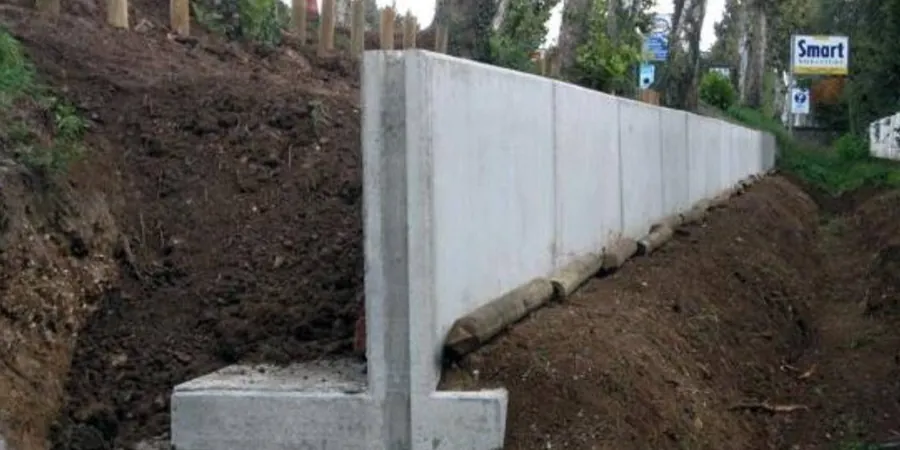
Local context
The ground beneath Northampton tells two different stories depending on which side of the Nene you stand. In Abington and the eastern suburbs, the Northampton Sand Formation provides a competent founding stratum with friction angles exceeding 34° and excellent drainage—walls here are usually straightforward, and the main risk is differential weathering of the ironstone bands. Cross the river into the floodplain around St James and Far Cotton, and the picture changes entirely. Here the alluvial clays and silts overlying the Lias can have undrained shear strengths below 35 kPa, and the groundwater sits shallow enough that a 2-metre excavation needs a well-point dewatering system just to keep the base dry. A retaining wall designed for the sand conditions simply does not work in the valley. The wall that stands safely in Kingsthorpe on weathered ironstone will slide or rotate in Far Cotton unless the design accounts for the lower strength and higher pore pressures. Our laboratory testing programme captures this spatial variability by running site-specific tests on samples from each borehole, not by applying a single conservative value across the whole site. When we report a friction angle of 23° for the Lias Clay at your wall location, that is the measured value from your actual ground, and your wall design depends on it.
Visual overview
Relevant standards
BS EN 1997-1:2004 (Eurocode 7) – Geotechnical Design, BS 5930:2015 – Code of practice for ground investigations, BS 8002:2015 – Code of practice for earth retaining structures, BS EN 1990:2002 – Basis of structural design
Additional services
Effective Stress Strength Testing
Consolidated-undrained triaxial tests with pore pressure measurement on 100 mm diameter undisturbed samples taken from the wall alignment. We run multi-stage tests to define the full Mohr-Coulomb envelope from a single specimen when material is limited, and we report effective cohesion and friction angle with the statistical confidence intervals your designer needs for partial factor application.
Consolidation and Settlement Analysis
Incremental loading oedometer tests that produce the constrained modulus, compression index, and coefficient of consolidation for each soil layer behind the wall. These parameters feed the serviceability limit state checks—particularly relevant in Northampton where differential settlement between the wall and adjacent structures on the Northampton Sand can cause serviceability issues even when ultimate limit states are satisfied.
Backfill Compaction and Shear Verification
Proctor compaction tests and large shear box testing at specified placement moisture and density. We test both imported granular fills and site-won materials to confirm the design friction angle is achievable under field compaction conditions, and we supply the compaction specification your contractor will follow during backfilling.
Typical parameters
Top questions
What type of retaining wall suits the Lias Clay found across Northampton?
In the Lias Clay that underlies much of Northampton, embedded cantilever walls or propped contiguous pile walls often perform better than gravity walls. The reason is the clay's medium to high plasticity, which generates significant lateral earth pressures when wetted. We typically measure effective friction angles between 22° and 26° and effective cohesion around 5 to 10 kPa from consolidated-undrained triaxial tests on undisturbed samples. These relatively low strength parameters mean a gravity wall would need an uneconomically large base width. Embedded walls bypass this by mobilising passive resistance below excavation level, but the design absolutely requires a reliable undrained shear strength profile obtained from site-specific laboratory testing—not from published correlations.
How much does a retaining wall design with ground investigation cost in Northampton?
A retaining wall design package with the necessary ground investigation and laboratory testing in Northampton typically ranges from £900 to £3,040. The final figure depends on the wall length, the number of boreholes or trial pits required, and the suite of laboratory tests specified. A small garden retaining wall under 1.5 metres height with one trial pit and basic classification plus shear box tests sits at the lower end. A full-height basement wall requiring rotary boreholes, multiple triaxial tests, oedometer consolidation tests, and a formal Geotechnical Design Report under Eurocode 7 reaches the upper end of that range.
What laboratory tests are essential for designing a cantilever retaining wall?
For a cantilever retaining wall design, the essential laboratory tests are consolidated-undrained triaxial tests to determine the effective stress strength envelope, Atterberg limits to classify plasticity, and particle size distribution to confirm the fines content. We also recommend oedometer consolidation tests if the wall will surcharge compressible strata. Moisture content and bulk density are measured on every undisturbed sample. When the wall is founded on or retains the Northampton Sand Formation, we add point load tests on ironstone fragments because the material can contain very strong bands that affect excavation methodology and drainage design.
How does the Nene Valley groundwater affect retaining wall design in Northampton?
Groundwater in the Nene Valley corridor is typically shallow, often encountered between 1.0 and 2.5 metres depth, and it fluctuates seasonally by a metre or more. This directly influences retaining wall design in three ways: it adds hydrostatic pressure to the lateral earth pressure, it reduces the effective stress in the retained soil mass, and it can soften the Lias Clay at formation level. Our laboratory testing programme includes permeability tests on undisturbed samples to estimate steady-state seepage rates, and we supply the unit weights and drained strength parameters that the designer needs to run effective stress analyses with a phreatic surface incorporated into the model.
Do you test the backfill material as well as the natural ground?
Yes, we routinely test both the natural ground and the proposed backfill material. For backfill, we run compaction tests—normally vibrating hammer for granular fills or standard Proctor for cohesive fills—to determine the maximum dry density and optimum moisture content. We also test the compacted material in a large direct shear box at the specified placement density to confirm the design friction angle is achievable. This is particularly relevant in Northampton where locally sourced crushed concrete from the town's former brickworks areas is sometimes used as structural backfill, and its shear strength must be verified rather than assumed.