The Northampton Sand Formation ironstone that underpins much of the town centre weathers into a variable, sometimes blocky material, but it is the overlying glacial till and pockets of Lias Clay that dictate most foundation behaviour here. Where the River Nene cuts through the valley, alluvial silts add another layer of complexity. A standard site investigation often stops at index properties, yet when an engineer needs to model drained versus undrained strength for a retaining structure or assess pore pressure build-up under a warehouse slab, the triaxial test becomes the reference point. In our background, combining triaxial data with CPT profiles across the Nene floodplain gives a far clearer picture of how the ground will respond under long-term loading than relying on SPT correlations alone. For projects on the stiffer till benches around Kingsthorpe, we also recommend grain size analysis to confirm the matrix composition before selecting the appropriate triaxial consolidation stage.
Getting the effective stress parameters right on Northampton’s glacial till can halve the foundation concrete volume compared to conservative total-stress assumptions.
Process overview
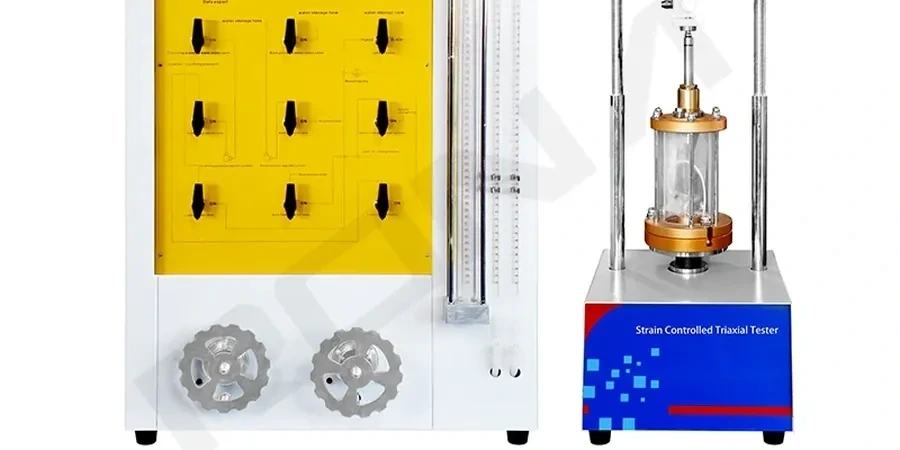
Local context
Northampton sits at the boundary between the Jurassic Lias Group and the overlying glacial deposits, creating a two-tier strength profile that catches out generic designs. The upper till can hold a perched water table after heavy rain—January 2024 saw 98 mm of rainfall in the county according to EA records—which reduces matric suction and lowers the effective stress in the shallow zone. On sites near the Nene, the alluvial clays have a plasticity index above 30%, meaning they develop significant excess pore pressure during undrained loading, and the triaxial test captures this directly through pore pressure measurement. Skipping consolidated-undrained testing on these soils leads to an overestimation of short-term bearing capacity, a risk we have seen materialise in temporary works failures on deep excavations where the contractor assumed drained parameters. The ironstone itself is less problematic, but its variable cementation means intact specimens can give misleadingly high cohesion; remoulded triaxial tests supply a safer lower-bound for slope stability analysis on cuttings along the A45 corridor.
Relevant standards
BS 1377-7:1990 Part 7, BS 1377-8:1990 Part 8, BS EN ISO 17892-8:2018, BS EN ISO 17892-9:2018, Eurocode 7 (BS EN 1997-2:2007)
Additional services
Consolidated-Undrained (CU) Triaxial
The workhorse test for Northampton’s clay soils. We measure undrained shear strength with pore pressure monitoring, delivering effective stress parameters c’ and φ’ for long-term stability analysis of cuttings and embankments on the A43 and M1 corridors.
Consolidated-Drained (CD) Triaxial
Slow-shear test for free-draining materials like the Northampton Sand Formation ironstone. Determines the true drained friction angle for retaining wall design where groundwater control is assured, with volume change measurement throughout the shear stage.
Unconsolidated-Undrained (UU) Triaxial
Quick total-stress test for cohesive soils, often used during earthworks QA on the glacial till. Provides a conservative undrained shear strength for short-term bearing capacity checks on pad footings in the Moulton Park industrial area.
Multi-Stage Triaxial with Stress Path
Advanced testing where a single specimen undergoes multiple consolidation and shear stages. Efficient for sites with limited borehole recovery, such as the stiff Lias Clay at depth, providing a full strength envelope from one high-quality sample.
Typical parameters
Top questions
How much does a triaxial test programme cost in Northampton?
A single CU or UU triaxial test typically falls between £120 and £190 depending on specimen diameter and consolidation stages. A full programme of three effective-stress tests with interpretation generally ranges from £1,350 to £2,310, depending on the number of specimens and the complexity of the stress path reporting required for your foundation design.
What soil types in Northampton require triaxial testing rather than shear box?
The Lias Clay and glacial till across Northampton are fine-grained soils where pore pressure behaviour during shear controls strength. Unlike the shear box, the triaxial cell allows drainage control and pore pressure measurement, which is essential for these materials. For the alluvial silts along the Nene floodplain, the triaxial test also provides a more reliable undrained strength than vane shear correlations because it replicates the in-situ stress state before shearing.
How long does a consolidated-undrained triaxial test take on Northampton clay?
For a typical Lias Clay specimen with a permeability around 10⁻⁹ m/s, the consolidation phase alone can take three to five days at 100 kPa increments. The shear stage, run at a rate slow enough to allow pore pressure equalisation—usually 0.002 mm/min—adds another two days. Including specimen preparation, saturation checks, and reporting, a CU test programme on these soils runs one to two weeks from sample receipt to final data delivery.
Do you provide drained triaxial parameters for the Northampton Sand ironstone?
Yes, we run consolidated-drained tests on the ironstone when it behaves as a free-draining granular material. However, the variable cementation of the Northampton Sand Formation means intact specimens often give high apparent cohesion that degrades with weathering. We typically recommend a combination of intact and remoulded CD tests to bracket the strength envelope, and we correlate the results with SPT N-values from the same borehole to check consistency across the site.