The Northampton Sand Formation dominates local geology, but its interbedded clays and silts directly overlie the Lias Clay. Just off Junction 15, we've seen liquid limits swing by 25 points within a single metre of borehole log. That variability matters. Whether it's for a cut-and-fill near the Nene Valley or a pad foundation in Duston, the Atterberg limits supply a direct measure of how the fine fraction will behave with water. The test defines two critical thresholds: the liquid limit, where soil flows under its own weight, and the plastic limit, where it crumbles rather than deforms. Between them lies the plasticity index, a parameter that governs shrink-swell potential and workability. Under BS 5930 and BS EN 1997, classification without these numbers is incomplete. We run the Casagrande cup and thread-rolling procedure on every sample that passes the 425-micron sieve, logging values that feed directly into earthworks specification and foundation design.
A plasticity index above 30 on Lias Clay in Northampton indicates high shrink-swell potential and demands a foundation depth below the zone of seasonal moisture variation.
Process overview
Local context
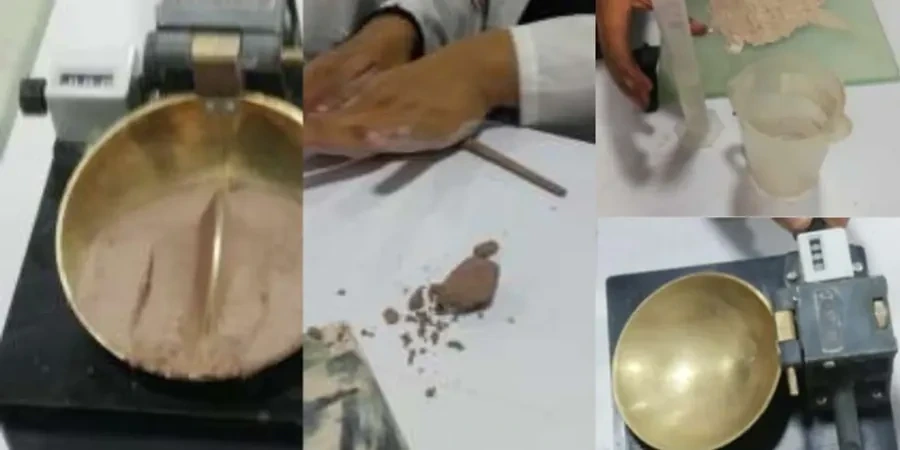
The Casagrande cup sits on a calibrated base with a 10 mm drop height. The cone penetrometer uses an 80 g cone with a 30-degree tip. Both instruments are checked daily against reference materials. Northampton's Lias Clay contains traces of pyrite, and oxidation during drying can alter the clay mineral surface chemistry. We air-dry samples below 50°C to preserve the original Atterberg values. A contractor who ignores a PI of 35 on a site near the Grand Union Canal risks differential heave that will crack blockwork within two seasonal cycles. The liquidity index, when natural moisture exceeds the plastic limit, quantifies that risk in numbers an engineer can act on. We flag any sample where the liquidity index exceeds 0.8, because that soil will remould under traffic and turn a formation into a pugging nightmare.
Relevant standards
BS EN ISO 17892-12:2018, BS 5930:2015 + A2:2020, BS EN 1997-2:2007 (Eurocode 7)
Additional services
Liquid & Plastic Limit
Cone penetrometer liquid limit and thread-rolling plastic limit on samples from cable percussion or window sampler boreholes. Includes natural moisture and liquidity index.
Shrinkage Limit
Mercury displacement or wax method to determine the shrinkage limit on high-plasticity Lias Clay. Used where volumetric stability is critical for slab-on-grade construction.
One-Point Liquid Limit
Rapid one-point cone method for site control during earthworks. Correlated against full five-point calibration for the specific Northampton formation encountered.
Plasticity Chart Interpretation
Classification to BS 5930 with Casagrande chart plotting. We supply a written summary linking PI to expected engineering behaviour, including shrink-swell and workability.
Typical parameters
Top questions
How much does Atterberg limits testing cost in Northampton?
A standard set of liquid and plastic limit tests on a single sample ranges from £40 to £70. The final cost depends on the number of samples and whether additional index tests like natural moisture content or particle size distribution are requested.
What soil types in Northampton most need Atterberg testing?
The Lias Clay and overlying glacial till are the two formations where Atterberg limits matter most. Both contain enough fines to exhibit plasticity, and both are widespread across the town. The Northampton Sand is generally non-plastic, but silt lenses within it can show low plasticity and should be tested if they will be compacted as fill.
Which standard do you follow for liquid limit determination?
We use the cone penetrometer method described in BS EN ISO 17892-12:2018. This is the preferred method under Eurocode 7 for UK geotechnical investigations and gives better repeatability on silty soils than the Casagrande cup.
How long does Atterberg testing take?
Standard turnaround is three to five working days from sample receipt. We can supply a 24-hour expedited service for earthworks control testing where the one-point liquid limit method is acceptable, provided the formation correlation has already been established.
What sample quantity is needed for Atterberg limits?
We need about 200 grams of material passing the 425-micron sieve. For a typical 100 mm diameter tube sample from a cable percussion borehole, a 300 mm length of core is sufficient, provided it comes from the zone of interest and is sealed immediately to prevent moisture loss.