Northampton's expansion from a Saxon settlement to a major logistics hub wasn't just about its central location. The Nene valley provided flat land but left a legacy of compressible alluvium and Lias Clay across the town. Any tunnel drive here cuts through deposits that change character within metres. We have logged boreholes near Delapré where stiff clay transitions to soft laminated silts over less than two metres of depth. The town sits at roughly 60 to 80 metres OD, with the river corridor acting as a collector for soft, high-plasticity sediments. For a project near the Waterside redevelopment, we combined our CPT testing with pore pressure dissipation to map the undrained shear strength profile before any TBM was ordered. If the alignment crosses the Northampton Sand Formation, which it often does in the northern wards, the ground conditions shift again into weakly cemented ironstone layers that behave as a completely different material. Our lab programme includes classification to BS 5930 and effective stress triaxial testing to define critical state parameters for these transitions.
A layered ground model for Northampton's Lias Clay, including the weathered crust and alluvial infill, is the difference between a smooth TBM drive and a settlement claim.
Process overview
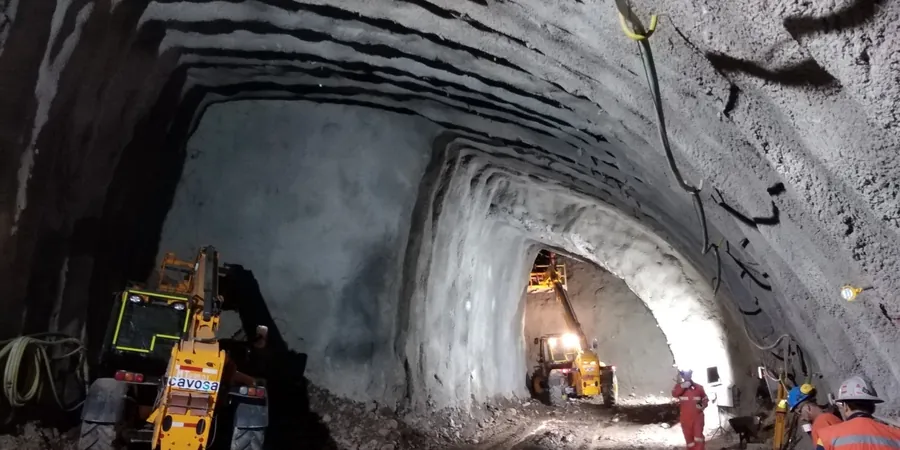
Local context
The mistake we see repeatedly in Northampton is designers treating the Lias Clay as a homogeneous medium and ignoring the weathered crust. A contractor near Kingsthorpe started a pipe-jacking operation assuming firm to stiff clay throughout the drive. They hit a pocket of saturated silt at the weathered interface and lost face control within half a day. The settlement trough opened up across a residential street and the repair costs dwarfed what a proper ground investigation would have cost. Soft soil tunnelling here demands a layered model. We run triaxial tests on undisturbed samples from within the weathered zone, not just from the intact clay below it, because the stiffness contrast is often 3:1 or greater. The second common failure is underestimating the groundwater response in the river terrace gravels. A depressurised aquifer can induce consolidation settlement at tunnel level even if the tunnel itself is stable. We combine standpipe piezometer data with laboratory permeability tests on the gravels to feed a coupled seepage-deformation analysis. Without that, the risk of differential settlement at the surface is just too high to accept.
Relevant standards
BS 5930:2015+A1:2020 – Code of practice for ground investigations, Eurocode 7 (BS EN 1997-1:2004+A1:2013) – Geotechnical design, BS EN 1997-2:2007 – Ground investigation and testing, BS 1377 – Methods of test for soils for civil engineering purposes
Additional services
Tunnel alignment ground investigation
Borehole and CPT campaigns along the proposed alignment with undisturbed sampling in soft clays and alluvium. We log to BS 5930 standards and produce a geotechnical baseline report that defines ground behaviour types for TBM selection and face pressure calculations.
Advanced laboratory testing for soft soils
Triaxial (CIU, CAU, CID) on high-quality samples from the Lias Clay weathered zone and alluvial deposits, incremental oedometer tests for consolidation parameters, and ring shear tests where residual strength governs stability at the face.
Typical parameters
Top questions
What ground investigation is required before tunnelling through Northampton's alluvial deposits?
A phased investigation starting with a geological desk study of the Nene valley deposits, followed by cable percussion boreholes with UT100 thin-wall sampling in the soft clays and peats. We recommend CPTU soundings at 20 to 30 metre intervals along the tunnel alignment for continuous profiling. Laboratory testing must include classification, oedometer consolidation, and CIU triaxial to define undrained strength for face stability analysis. The BS 5930:2015 framework governs the investigation density.
How do you estimate the cost of a soft soil tunnel geotechnical analysis in Northampton?
For a typical tunnel investigation in Northampton, the geotechnical analysis cost ranges from £2,980 for a targeted scope covering a short drive length with limited lab testing, up to £15,260 for a comprehensive programme including multiple boreholes, CPTU profiles, triaxial and oedometer testing, and a full geotechnical interpretative report with numerical analysis. The final figure depends on the alignment length, ground variability, and access constraints in urban areas.
Which soil parameters are critical for TBM face pressure design in the Lias Clay?
The undrained shear strength profile through the weathered crust is the first priority, because it controls the minimum face support pressure to prevent collapse. We also measure the effective friction angle from CAU triaxial for drained analysis in the Northampton Sand sections. The coefficient of earth pressure at rest (K0) in the high-plasticity Lias Clay typically exceeds 1.5 due to overconsolidation, and getting this wrong leads to underestimated long-term lining loads.