In-situ testing forms the backbone of reliable geotechnical investigation across Northampton, providing engineers and contractors with direct measurements of ground conditions without disturbing the natural state of the soil. This category encompasses a wide range of field-based techniques that evaluate soil strength, density, permeability, and deformation characteristics right where they matter most: on the construction site itself. In a town experiencing steady residential expansion and commercial redevelopment, the accuracy of in-situ data directly influences foundation design, earthworks specification, and long-term structural performance. Unlike laboratory tests on extracted samples, these methods capture the true behaviour of soils under their existing stress conditions, moisture regimes, and stratigraphic context.
Northampton sits on a varied geological foundation that makes in-situ testing particularly valuable. The town straddles the Jurassic Northampton Sand Formation, a ferruginous sandstone that can present variable cementation and weathering profiles, overlying Lias Group mudstones and clays. River valleys, including the Nene, introduce alluvial deposits with pockets of soft silts and peats that can challenge construction without proper characterisation. Glacial tills and head deposits across the area further complicate the ground profile, creating a patchwork of materials with contrasting engineering properties. Understanding these local conditions through direct field measurement helps mitigate the risks associated with differential settlement, bearing capacity failure, and groundwater-related issues that have historically affected developments in the region.
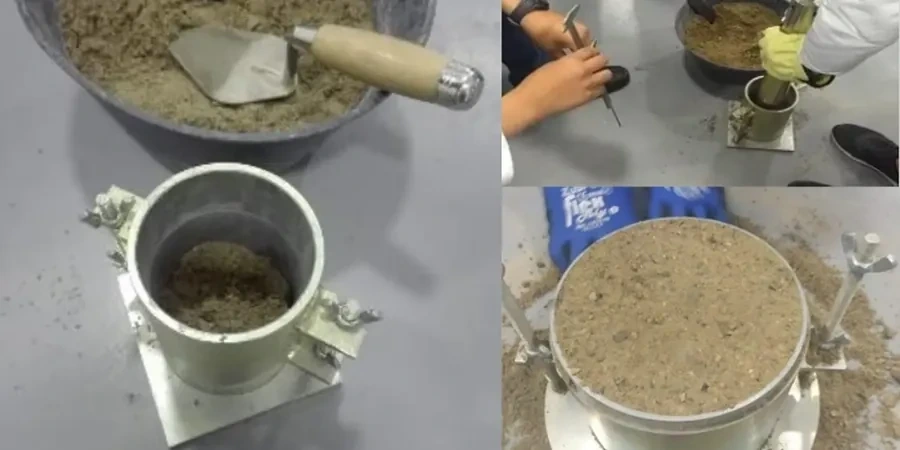
All in-situ testing carried out in Northampton must comply with the relevant British Standards, primarily BS EN ISO 22476 for field testing and BS 5930 for the wider code of practice for ground investigations. These standards set out rigorous procedures for equipment calibration, test execution, and data interpretation, ensuring results are reproducible and admissible for design purposes. The UK Specification for Ground Investigation, published by the Institution of Civil Engineers, provides additional guidance on test selection and frequency. For highway and infrastructure projects, adherence to the Design Manual for Roads and Bridges and local Northamptonshire County Council requirements may also apply, particularly where earthworks and pavement design are concerned.
The range of projects requiring in-situ investigation in Northampton spans from small-scale residential extensions to major infrastructure schemes. Housing developers rely on these methods to confirm bearing capacities and identify any made ground from the town's industrial past, while commercial builds in areas like Brackmills Industrial Estate demand precise data for heavily loaded floor slabs and crane outriggers. Road widening and roundabout improvements around the Northampton ring road necessitate accurate compaction control, often verified through methods such as the field density test (sand cone method). Rail infrastructure, flood defence works along the Nene, and utility trenching all benefit from the rapid, cost-effective data that in-situ techniques supply, enabling confident design decisions without the delays associated with extensive laboratory programmes.
Available services
Quick answers
What does in-situ testing mean in ground investigation?
In-situ testing refers to geotechnical tests performed directly in the ground at the project site, without removing soil samples for laboratory analysis. It measures properties like density, strength, and permeability under natural conditions, preserving the soil's existing stress state, moisture content, and structure. This approach often yields more representative data than disturbed sampling, especially in granular or sensitive soils.
When is in-situ testing required for construction projects in Northampton?
In-situ testing is typically required during the ground investigation phase of any construction project where foundation design, earthworks, or retaining structures are involved. Northampton's varied geology, including Northampton Sand and river alluvium, means local planning authorities and building control often mandate site-specific data to satisfy Building Regulations Part A (Structure) and ensure safe, serviceable designs.
How do British Standards govern in-situ testing procedures?
BS EN ISO 22476 provides the primary framework for field testing in the UK, setting out requirements for equipment, calibration, and test execution. BS 5930 offers broader guidance on investigation planning and interpretation. These standards ensure consistency and reliability, and adherence is expected by regulators, insurers, and clients across all construction sectors in Northampton.
What are the advantages of in-situ tests over laboratory soil testing?
In-situ tests avoid the disturbance that occurs during sampling, transport, and preparation, which can significantly alter soil properties, particularly in sands and silts. They supply continuous or closely spaced data with depth, enable testing of difficult-to-sample materials, and deliver immediate results that can inform real-time decisions on earthworks compaction and foundation bearing levels.