Ground improvement in Northampton represents a critical branch of geotechnical engineering focused on modifying the in-situ properties of soils to meet the demands of modern construction. This category encompasses a suite of techniques designed to increase bearing capacity, reduce total and differential settlements, mitigate liquefaction potential, and accelerate the consolidation of weak or compressible ground. For a town experiencing steady residential and commercial expansion, particularly within the Northampton Waterside Enterprise Zone and surrounding logistics hubs, the ability to safely and economically build on marginal land is paramount. Without engineered ground improvement, developers face costly deep foundations or the outright rejection of sites underlain by soft alluvium, made ground, or loose granular deposits.
The local geology of Northampton is dominated by the Middle Lias Clays and Silts, overlain in the river valleys by significant thicknesses of Quaternary alluvium. The River Nene and its tributaries have deposited extensive layers of soft silty clays, peats, and loose saturated sands across the valley floor, creating challenging conditions for shallow foundations. These deposits often exhibit low shear strength and high compressibility, while the loose granular layers can be susceptible to densification and, in seismic scenarios, liquefaction. Understanding this interplay between the competent bedrock of the Northampton Sand Formation and the problematic superficial deposits is the starting point for any effective ground improvement strategy. Site-specific ground investigation to BS 5930 is essential to characterise the depth, density, and consistency of these layers before selecting an appropriate technique.
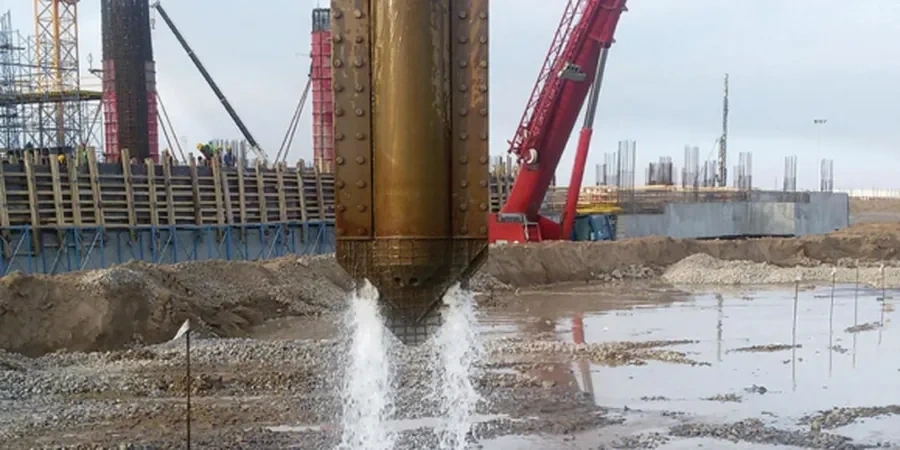
All ground improvement works in the UK must comply with the overarching framework of Eurocode 7 (BS EN 1997-1 and -2) for geotechnical design, implemented alongside its UK National Annex. The execution of specific techniques is governed by standards such as BS EN 14731 for deep vibration methods and BS EN 15237 for vertical drains. For projects where vibro-techniques are identified as the optimal solution, the detailed design process for vibrocompaction design must rigorously assess the gradation and fines content of the granular soils to confirm treatability. Equally critical is adherence to the CDM 2015 regulations, ensuring that health and safety risks associated with large vibratory plant and the handling of stone aggregates are managed from the design phase onward. A robust design will also integrate environmental constraints, such as vibration monitoring near sensitive structures, which is a frequent requirement on Northampton's brownfield sites.
The types of projects that routinely require ground improvement in Northampton are diverse. Large-footprint industrial warehouses and distribution centres, prevalent along the M1 corridor, demand strict settlement tolerances for floor slabs, often making stone column design a cost-effective alternative to piling. Residential developments on former marshland or infilled clay pits utilise preloading with vertical drains or dry soil mixing to create stable platforms. Infrastructure works, including road embankments and flood defence levees, rely on basal reinforcement and deep vibration to ensure stability over the soft alluvial soils of the Nene Valley. Even smaller commercial builds on cramped urban plots can benefit from targeted compaction grouting to address isolated zones of made ground, demonstrating the versatility of these methods across scales.
Available services
Quick answers
What is the primary purpose of ground improvement in construction?
The primary purpose is to engineer the ground to reliably support structural loads without excessive settlement or failure. It enhances weak or variable soils by increasing bearing capacity, reducing compressibility, and mitigating risks like liquefaction, effectively making a site safe and economically viable for development where conventional shallow foundations would be inadequate.
How do I know if my Northampton site requires ground improvement?
A comprehensive ground investigation to BS 5930 is the definitive method. Indicators include the presence of soft alluvial clay, peat, loose sands, or deep made ground in the Nene Valley. If preliminary assessments or nearby historical data suggest low bearing capacity or high settlement potential, a geotechnical engineer will evaluate the need for treatment.
What are the key regulations governing ground improvement in the UK?
Design is governed by Eurocode 7 (BS EN 1997) and its UK National Annex. Execution standards like BS EN 14731 for deep vibration apply to specific techniques. All works must comply with CDM 2015 regulations for health and safety, and often require planning conditions addressing environmental impacts such as noise and vibration.
What are the main techniques for treating loose granular soils?
Deep vibratory methods are the standard solution. Vibrocompaction densifies clean, granular soils in-situ using a depth vibrator, rearranging particles into a denser state. For silty sands or soils with some fines, stone columns may be more appropriate, creating stiff, draining inclusions that reinforce the mass while also densifying the surrounding ground.