One of the costliest mistakes we see in Northampton is treating the Nene Valley's sand and gravel terraces as inherently stable under seismic load. When saturated fine sands lose strength during ground shaking, the consequences for foundations can be severe even at relatively low seismic intensities. In our background, developers who commission a soil liquefaction analysis early avoid expensive redesign loops later. The British Geological Survey maps much of central Northampton as underlain by Quaternary alluvium and river terrace deposits—materials that demand careful evaluation. A desk study alone will not flag the problem; we combine field investigation with laboratory cyclic testing to determine the factor of safety against liquefaction. The process ties directly into the requirements of CPT testing when continuous profiling is needed through interbedded silts, and often runs alongside grain size analysis to check the fines content that strongly influences cyclic resistance.
Liquefaction in Northampton is not about big earthquakes—it is about loose saturated sands within 4 metres of the surface and a water table that stays high all year.
Process overview
Local context
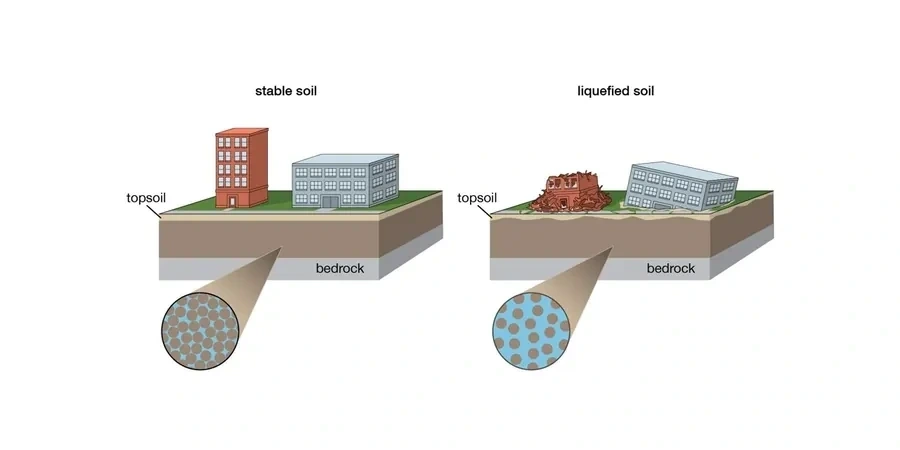
In Northampton, we consistently find that the greatest liquefaction risk hides in the upper 5 metres of alluvial sands—the very zone where shallow foundations and service trenches are placed. What catches many contractors off guard is the seasonal persistence of the water table; even during dry summers, the gravel aquifer keeps the fine sand lenses saturated. When a project sits on the floodplain between Brackmills and the Nene, the stratigraphy often includes a thin silt cap over clean sand, a profile that is textbook-prone to lateral spreading toward the river channel. The damage cascade is not theoretical: differential settlement, loss of bearing capacity, and utility rupture can render a building uninhabitable. Our soil liquefaction analysis quantifies this risk before the first cubic metre of concrete is poured, allowing the design team to choose between Improvement or a piled solution with confidence.
Relevant standards
BS EN 1997-1:2004 (Eurocode 7: Geotechnical design – Part 1: General rules), BS 5930:2015+A1:2020 (Code of practice for ground investigations), BS EN ISO 22476-1:2012 (CPT and CPTU – Field testing), BS EN ISO 22476-3:2005+A1:2011 (SPT – Field testing), BS 1377-8:1990 (Shear strength tests – cyclic triaxial)
Additional services
Screening-Level Liquefaction Assessment
We review existing borehole logs, CPT data, and BGS mapping to determine whether the site falls within a liquefaction-susceptible zone. This phase uses the simplified Seed-Idriss procedure and provides a go/no-go recommendation for further investigation.
Advanced Laboratory Testing Programme
When in-situ tests show marginal safety factors, we design a cyclic triaxial testing programme on high-quality undisturbed samples. The results feed into site-specific cyclic resistance curves, replacing generic correlations with measured behaviour of the Northampton sands.
Mitigation Design and Verification
Where liquefaction risk is confirmed, we specify Improvement techniques—vibrocompaction, stone columns, or rigid inclusions—and design a post-treatment verification campaign using CPT and crosshole seismic testing to confirm densification has been achieved.
Typical parameters
Top questions
Is Northampton in a seismic zone that requires liquefaction analysis?
Seismic hazard in the East Midlands is low to moderate, but Eurocode 7 and the UK National Annex require a liquefaction assessment whenever loose saturated sands are present within 20 m of the surface. Parts of central Northampton along the Nene floodplain meet these conditions, so the analysis is often a planning or NHBC requirement.
How much does a soil liquefaction analysis cost in Northampton?
For a typical Northampton site, a soil liquefaction analysis ranges from £2.150 to £3.710, depending on the number of boreholes or CPT soundings needed and whether laboratory cyclic triaxial testing is required. We supply a fixed-price proposal after reviewing existing ground investigation data.
What happens if my site fails the liquefaction assessment?
A failed assessment does not stop the project—it triggers mitigation. We evaluate options such as vibrocompaction, stone columns, or piled foundations, then design a Improvement specification and a verification testing plan. The goal is to raise the factor of safety above the threshold so construction can proceed with building control approval.