Northampton sits on a variable geological foundation that transitions from Northampton Sand Formation ironstone ridges to the softer Lias Group mudstones and clays along the River Nene floodplain. These Jurassic and Triassic sequences create a patchwork of bearing capacities and drainage characteristics that cannot be reliably assessed from borehole logs alone. When a developer in the Brackmills industrial area needed to confirm the thickness of alluvial silts before placing pad footings for a 4000 m² warehouse, the cone penetration test provided a continuous resistance profile that exposed a 1.6-metre soft pocket missed by earlier trial pits. The CPT rig measures tip resistance and sleeve friction every 10 mm, generating a near-continuous stratigraphic signature that reveals thin compressible layers, desiccated crusts, and the exact depth to competent bearing strata. Triaxial testing on samples retrieved at depths identified by CPT then confirmed the effective stress parameters for the foundation design.
Cone penetration testing in Northampton's Lias Clay reveals thin compressible seams that conventional borehole spacing will miss every time.
Process overview
Local context
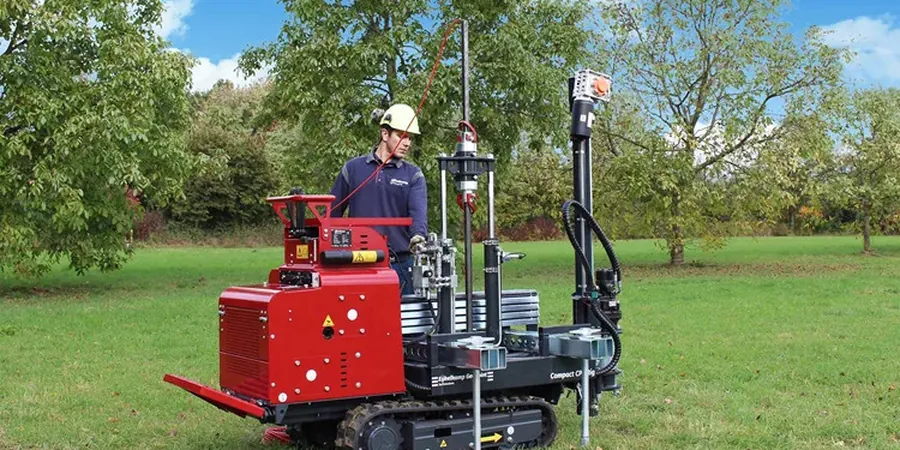
The hydraulic thrust system on a CPT rig generates up to 200 kN of continuous push force, and in Northampton's seasonally desiccated upper clay crust this can create a refusal condition at shallow depth if the weathered zone is not pre-drilled. Our operators read the real-time data stream on screen inside the control cabin, watching for the characteristic pore pressure drop that signals a transition from cohesive to granular material—a signature that appears frequently where Northampton Sand overlies the Lias. When the friction ratio spikes and the tip resistance drops simultaneously, the experienced eye recognises a potential cavity or solution feature in the limestone bands within the Marlstone Rock Bed. We pre-bore through made ground and road base layers using hollow-stem auger techniques so the cone enters natural ground cleanly, eliminating the data contamination that plagues CPT records when rigs push through rubble fill without preparation. The interpretation software applies the Robertson (1990) soil behaviour type chart corrected for Northampton's intermediate clay-sand mixtures.
Relevant standards
BS 5930:2015 + A1:2020 Code of practice for ground investigations, BS EN ISO 22476-1:2012 Geotechnical investigation and testing — Field testing — Part 1: Electrical cone and piezocone penetration test, Eurocode 7 BS EN 1997-2:2007 Geotechnical design — Part 2: Ground investigation and testing, with UK National Annex
Additional services
Piezocone penetration testing (CPTu)
Full seismic piezocone deployment with u2 pore pressure measurement at the cone shoulder. Provides corrected tip resistance qt, sleeve friction fs, and dissipation tests at predetermined depths to derive the coefficient of consolidation cv. Essential for settlement rate predictions in Northampton's Mercia Mudstone and Lias Clay formations where consolidation governs the construction programme. Data processed with Robertson (1990) and Lunne et al. (1997) classification systems, output as digital logs compatible with HoleBASE and gINT formats.
Targeted CPT investigation for shallow foundations
Rapid site screening across Northampton's river terrace gravels and alluvial corridors using a 20-tonne tracked CPT rig with 200 kN push capacity. We map the gravel-clay interface to within 0.1 m vertical accuracy, identifying the bearing stratum for traditional strip footings and pad foundations. Includes friction ratio classification, undrained shear strength profiles via Nkt cone factor calibrated to Northampton clay, and relative density estimates for granular layers using the Baldi correlation.
Typical parameters
Top questions
How much does a CPT cone penetration test cost in Northampton?
CPT testing in Northampton typically ranges from £140 to £180 per test location when conducted as part of a multi-point site investigation programme. The exact cost depends on the total depth required, whether pore pressure (CPTu) measurement is included, and the number of dissipation tests specified. A routine investigation across a standard residential plot in the Northampton area with three CPT soundings to 10 m depth and one dissipation test per sounding would fall toward the lower end of that range. Mob-demob charges apply separately and are reduced when combining CPT with other investigation methods.
What depth can CPT testing reach in Northampton's geology?
In the Lias Clay and Mercia Mudstone that dominate Northampton's subsoil, our 200 kN CPT rig routinely achieves depths of 20 to 25 metres before reaching refusal. Where the Northampton Sand Formation contains well-cemented ironstone bands, refusal may occur at shallower depths of 8 to 12 metres. We pre-bore through made ground and the desiccated crust to avoid premature refusal in the upper 1.5 metres. For sites requiring deeper profiles into the underlying Penarth Group, we can combine CPT soundings with rotary-cored boreholes at selected locations.
How does CPT compare to traditional borehole investigations?
CPT provides a continuous vertical profile of soil resistance measured every 10 to 20 millimetres, whereas a borehole with SPT testing typically provides data at 1.5-metre intervals. This continuous record is critical in Northampton's interbedded Northampton Sand and Lias sequences where a 200 mm soft clay seam between two stiff layers can govern foundation performance but is easily missed by spaced SPT samples. CPT also eliminates sample disturbance issues and provides pore pressure data that directly informs consolidation analysis. However, CPT does not recover physical samples for laboratory classification, so the ideal investigation strategy pairs CPT profiling with targeted sampling boreholes at locations identified by the cone data.
Is CPT suitable for assessing liquefaction risk in Northampton?
Northampton sits in a very low seismicity region under current UK hazard maps, and the dense, overconsolidated nature of the Lias Clay and Mercia Mudstone means liquefaction is not a practical design concern for most sites. CPT is the international standard method for liquefaction assessment per the NCEER and Boulanger-Idriss procedures, and we can apply these analyses where granular alluvial deposits are present along the Nene valley or where sand lenses within the Northampton Sand Formation warrant evaluation. The CPT tip resistance and sleeve friction data feed directly into the cyclic resistance ratio calculation without the correction factors required for SPT-based methods.