Foundation engineering in Northampton represents far more than simply placing concrete in the ground. It is a sophisticated discipline that must reconcile structural loads with the often unpredictable ground conditions found across the county. From the historic town centre, with its legacy of medieval cellars and backfilled pits, to the expansive clay vales that characterise the surrounding landscape, a robust foundation strategy is the single most critical factor in ensuring the longevity and stability of any building. Neglecting a proper ground investigation before construction can lead to differential settlement, cracking, and ultimately catastrophic structural failure, making specialist geotechnical input indispensable from the earliest design stages.
Northampton sits predominantly on the Lias Group, a geological formation that presents a classic 'shrink-swell' hazard due to its high clay content. These clays are notoriously moisture-sensitive, expanding significantly in wet winters and contracting during dry summers. This seasonal volumetric change exerts immense stress on shallow foundations, which is why many modern projects in the area must look to deeper solutions. Additionally, the Nene Valley corridor introduces layers of alluvial sands and gravels, often with a high water table, posing challenges for excavation stability and bearing capacity. Understanding this local geological patchwork is not optional; it is the bedrock of effective foundation design in the region.
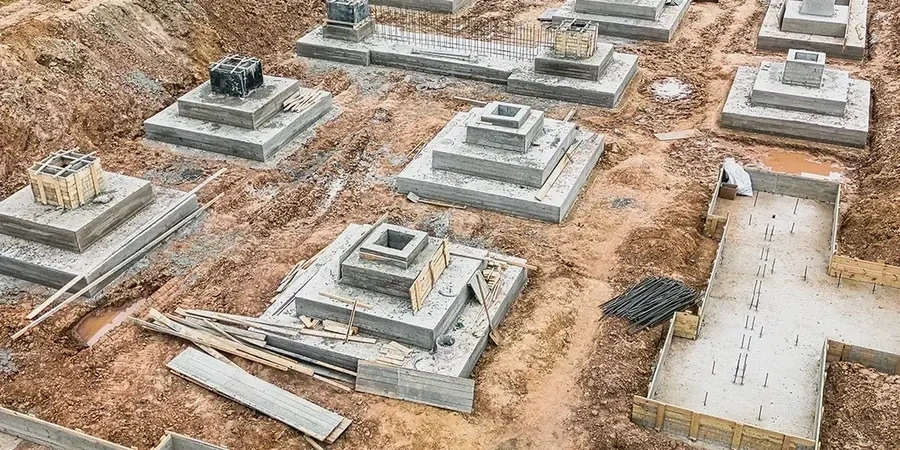
All foundation works in Northampton must strictly adhere to the comprehensive framework of British Standards, most critically Eurocode 7 (BS EN 1997), which governs geotechnical design. This is supplemented by the UK National Annex to BS EN 1997-1, which provides specific parameters and partial factors for the UK's ground conditions. The execution of any ground investigation must follow BS 5930, the code of practice for site investigations, while the design and construction of concrete elements fall under BS EN 1992 (Eurocode 2) and BS 8500. Compliance with these standards, along with the robust requirements of building control bodies like North Northamptonshire Council, is a legal and professional necessity to assure a safe and insurable structure.
The type of project dictates the foundation approach. For a lightweight residential extension on a shrinkable clay site, a deepened trench fill foundation might suffice, provided it is reinforced to resist lateral soil pressures. However, for multi-storey commercial developments or structures on the softer alluvial soils near the River Nene, a deeper, load-bearing solution is mandatory. This is where pile foundation design becomes the primary focus, transferring structural loads through the weak superficial layers down to the competent mudstone or a dense granular stratum. Similarly, industrial warehouses with heavy floor loadings and sensitive infrastructure projects like highway bridges require exhaustive ground modelling to select the correct foundation typology, be it a raft, piled raft, or discrete pad and ground beam system.
Available services
Quick answers
What is the most common foundation problem in Northampton's clay soils?
The primary issue is shrink-swell behaviour in the Lias Clay. Seasonal moisture changes cause the soil to expand and contract, which can lead to differential movement and cracking in shallow foundations. Designing to a depth where moisture content is stable or using piled solutions that bypass the active zone are the standard engineering responses to mitigate this risk.
Do I always need a deep foundation in Northampton, or can I use a traditional strip footing?
Not always, but it depends entirely on the ground conditions revealed by a site investigation. Traditional strip footings may be acceptable on low-plasticity soils or granular deposits with sufficient bearing capacity and no trees nearby. However, on highly shrinkable clay or in areas with made ground, a deeper trench fill or a piled foundation is often mandated by structural engineers to ensure stability.
What regulations control foundation design and construction in the UK?
Foundation design is primarily governed by Eurocode 7 (BS EN 1997) and its UK National Annex, which set out the requirements for geotechnical design. Construction execution must comply with Eurocode 2 (BS EN 1992) for concrete and BS 8004 for earthworks. All works are also subject to approval from Building Control, who will require proof of compliance with these standards.
How important is a ground investigation before starting foundation work?
It is absolutely essential and a core requirement of BS 5930. Without a proper investigation, the design is based on assumption, which is unsafe and uninsurable. The investigation determines soil strength, chemistry, groundwater levels, and the presence of any hazards, providing the design parameters needed to select the correct foundation type and depth for the specific site.