A surprisingly common mistake in Northampton is assuming that a single Proctor test specification works for every material on site. The Northampton Sand Formation, a historically important ironstone and sand unit that underlies much of the town, behaves entirely differently under compaction than the overlying glacial till or the Lias Clay found in the Nene Valley. We see contractors specifying Modified Proctor effort for a sandy sub-base, only to discover the clay layers nearby require a completely different moisture-density framework. The sand cone density method is often paired with this to verify achieved dry density in the field. Ignoring the geological variability between the Northampton Sand and the Whitby Mudstone Formation leads to either under-compaction or unnecessary rework. Our laboratory team runs both Standard and Modified Proctor tests to BS 1377-4:1990, helping engineers in Northampton match the right compactive effort to the right formation.
Selecting the wrong Proctor method in Northampton can make a material look like it has failed, when in reality the compactive effort was mismatched to the geology.
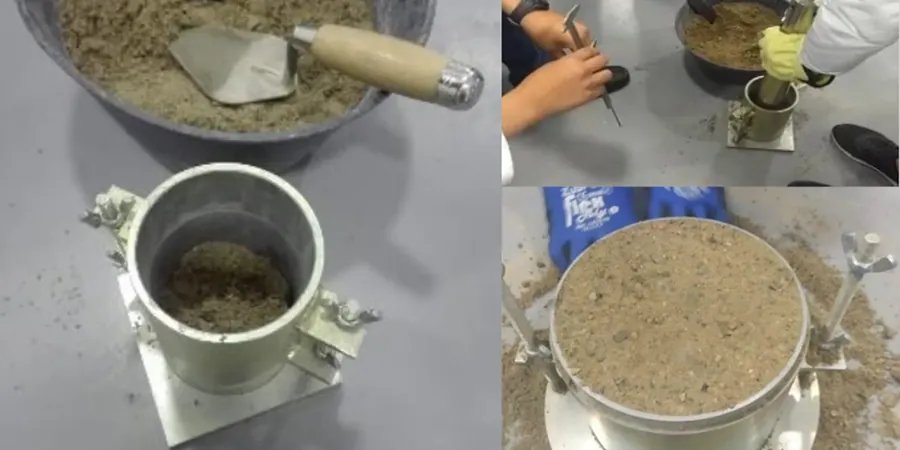
Process overview
Local context
In Northampton, we often see fill failures that trace back not to poor compaction technique, but to a simple mismatch between the laboratory Proctor reference and the field compactive effort. A contractor compacts a Lias Clay fill with a heavy sheepsfoot roller, which delivers effort closer to Modified. If the laboratory only ran a Standard Proctor, the field results will look impossibly high, and the contractor might reject perfectly sound work. The opposite problem is worse. When a trench is backfilled with a granular Northampton Sand using only a small vibrating plate, the field effort resembles Standard compaction. A Modified-based target density will never be met, leading to settlement and cracked pavements. The Atterberg limits test helps us identify whether the clay fraction is high enough that moisture conditioning will be the dominant variable, not just the number of passes. Getting the Proctor reference right before earthwork starts avoids weeks of contractual arguments.
Relevant standards
BS 1377-4:1990 (Compaction-related tests), BS EN 1997-2:2007 (Eurocode 7 Ground investigation and testing), Manual of Contract Documents for Highway Works (MCHW) Series 600, NHBC Standards Chapter 4.2 (Building near trees)
Additional services
Standard Proctor (BS Light)
The 2.5 kg rammer method for fine and medium-grained soils, commonly specified for clay fill in landscaping and low-rise housing. We report optimum moisture content and maximum dry density in Mg/m³, with the full moisture-density curve plotted.
Modified Proctor (BS Heavy)
The 4.5 kg rammer method for granular sub-base, road capping, and heavily trafficked areas. Essential for Northampton Sand Formation materials where a higher target density is expected by the pavement design.
Field Density Correlation
We pair laboratory Proctor values with sand cone or nuclear gauge field tests, producing air voids ratios and relative compaction percentages that satisfy MCHW Series 600 end-product specifications.
Typical parameters
Top questions
How much does a Proctor test cost in Northampton?
A single Standard or Modified Proctor test typically ranges from £80 to £170, depending on the material type and whether it is fine-grained or granular. Granular soils sometimes require the larger CBR mould, which takes more material and time. A full moisture-density relationship with five points will be at the upper end of that range.
Which Proctor test should I use for Northampton Sand?
For Northampton Sand used as a capping or sub-base layer under roads, the Modified Proctor is usually appropriate because the material is granular and will be placed with heavy vibratory rollers. If the sand is being used as general fill behind a retaining wall with only light compaction, the Standard method can be more realistic.
Can you test chalk fill from the local area?
Yes. Chalk is encountered in some of the deeper excavations towards the east of Northampton. Chalk requires careful handling because the Proctor test can crush the chalk pieces, artificially altering the grading. We follow the guidance in BS 1377-4 and CIRIA C574 for chalk compaction, including measuring the saturation moisture content.
What is the difference between end-product and method specification?
Method specification tells the contractor exactly how to compact the fill: layer thickness, roller type, number of passes. End-product specification sets a target relative compaction, say 95% of Modified Proctor maximum dry density, and lets the contractor achieve it however they wish. Most Northampton road jobs now use end-product specification, which means the Proctor reference density becomes the single most important number in the earthwork contract.