Ground conditions shift noticeably across Northampton. The ironstone hills around Kingsthorpe sit on well-drained brashy soils, while the Nene Valley floor near Upton brings you into soft alluvium and pockets of historic made ground. A raft foundation design has to work with both extremes. On the higher ground, we deal with shrinkable clay behaviour. Down by the river, we check for compressible layers that would overload conventional footings. The town's development over former quarry sites adds another layer of complexity. Before committing to a structural layout, we often pair the raft analysis with a CPT test programme to map soft zones continuously, or run grain-size checks where silty bands appear in the borehole logs.
A properly designed raft foundation bridges Northampton's mixed ground, from ironstone brash to Nene alluvium, in a single structural element.
Process overview
Local context
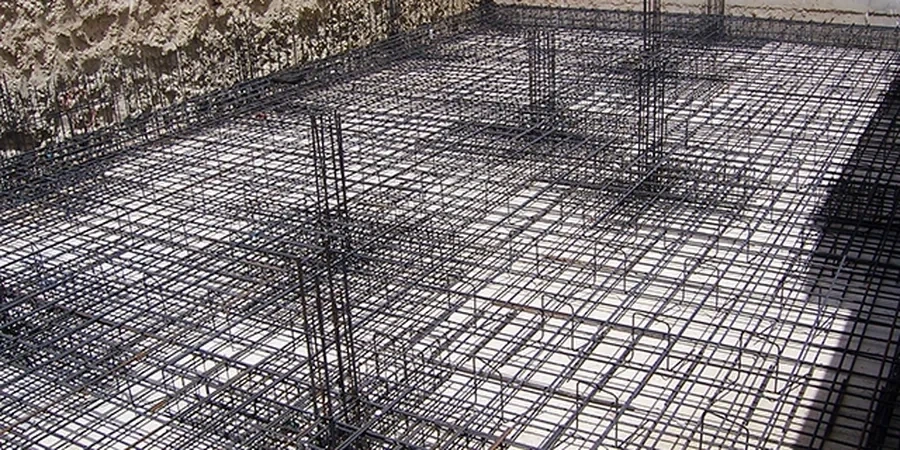
A three-storey apartment block off Harlestone Road had a problem. The boreholes showed firm clay to 5 metres, then a band of saturated silt the previous desktop study missed. Differential settlement would have cracked the blockwork within two years. We redesigned the foundation as a stiffened raft with edge beams, transferring load past the weak layer into the deeper competent clay. Northampton's industrial history leaves behind undocumented backfill. Old brick pits, filled railway cuttings, and buried culverts can sit right under the footprint. A standard strip footing fails on that ground. The raft bridges the inconsistencies. We also check for long-term consolidation in the Lias Clay, which can settle slowly and unevenly. Ignoring that behaviour leads to serviceability failures you cannot economically fix post-construction.
Relevant standards
BS EN 1997-1:2004 (Eurocode 7: Geotechnical design), BS EN 1992-1-1:2004 (Eurocode 2: Design of concrete structures), BS 5930:2015 (Code of practice for ground investigations)
Additional services
Geotechnical Interpretative Report
We interpret borehole and CPT data specifically for raft design, identifying the bearing stratum and any soft inclusions beneath the Northampton footprint.
Settlement and Bearing Analysis
FEA modelling of the soil-raft interaction using site-derived subgrade reaction profiles. Includes immediate and consolidation settlement predictions.
Reinforced Concrete Raft Detailing
Full bending moment and shear diagrams with reinforcement schedules. Edge beam and service penetration detailing included.
Construction Phase Monitoring
Settlement markers and piezometer installation plans to verify design assumptions during raft construction and initial loading.
Typical parameters
Top questions
What does a raft/mat foundation design cost in Northampton?
For a single dwelling on a standard plot, design fees typically range from £820 to £1.450. Larger commercial or multi-storey projects fall between £1.800 and £3.650, depending on ground complexity and whether FEA modelling is required.
When is a raft better than strip footings in Northampton?
A raft works when the bearing capacity is marginal, settlement needs to be evened out, or the soil contains soft pockets. It suits Northampton's shrinkable clays and made-ground sites where trench fill would be uneconomical.
How long does the design process take?
Once the ground investigation data is complete, we deliver the initial design package within 12 to 15 working days. Complex sites with basement retaining elements may add a week.