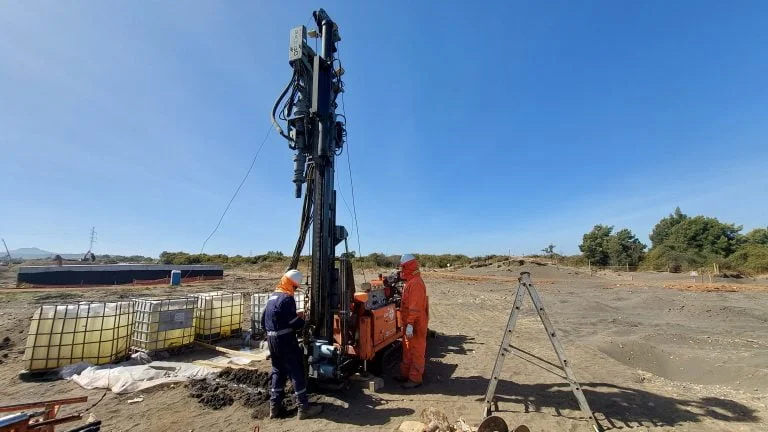
Northampton sits on a varied geological sandwich: Jurassic limestone and clay ridges to the west, and the alluvial sands and gravels of the River Nene floodplain to the east. With over 220,000 residents and major brownfield regeneration reshaping the Waterside and town centre, knowing what lies beneath the surface before breaking ground is not optional. An exploratory test pit provides direct visual access to shallow strata, letting you see soil structure, moisture, and fill material with your own eyes. Our team has opened test pits across Delapré, Kingsthorpe, and the expanding Upton estate, feeding site observations straight into foundation design, drainage strategy, and contamination screening. Where the ground profile hints at deeper variability, we often pair the pit with SPT drilling to extend the investigation depth without losing context.
A test pit turns a borehole description into something you can photograph, measure, and sample with full confidence in the ground truth.
Process overview
Local context
Northampton’s winters bring sustained saturation into the Lias Clay slopes that fringe the town’s western edge, while summer shrinkage opens cracks that mislead the untrained eye. Opening a test pit in February reveals groundwater perched within the weathered clay zone; the same pit in August can look bone-dry at the surface but still hold a soft, over-consolidated layer at two metres. The risk of misreading seasonal moisture as permanent drainage capacity is real, and it has led to foundation under-design on more than one extension project near Hunsbury Hill. Our pit logs always record the weather window, recent rainfall, and water strike timing so the design team can interpret the profile in context, not in isolation. For sites within the Nene flood corridor, we also assess the potential for sand lenses acting as preferential drainage paths that compromise soakaway performance.
Visual overview
Relevant standards
BS 5930:2015 + A1:2020 — Code of practice for ground investigations, Eurocode 7 (BS EN 1997-2:2007) — Ground investigation and testing, HSG150 — Health and Safety in Excavations
Additional services
Foundation inspection pits
Opened adjacent to existing structures or at proposed footing locations to log bearing stratum, identify desiccated clay zones, and assess the need for trench fill depth adjustment.
Infiltration and drainage test pits
Positioned at planned soakaway locations; includes falling-head percolation testing in accordance with BRE Digest 365 and soil classification for discharge consent applications.
Material re-use and contamination screening
Stratified sampling of natural soils and made ground for chemical analysis and geotechnical classification, supporting the Materials Management Plan required by Northamptonshire County Council.
Typical parameters
Top questions
What does an exploratory test pit cost in Northampton?
For a standard single-day investigation with a tracked excavator, operator, and geotechnical engineer on site, you can expect between £370 and £610. The final figure depends on access constraints, number of pits, depth, and whether you require soakage testing or laboratory analysis.
Do I need a permit to open a test pit on my property?
On private land, no statutory permit is required from the council, but you must notify the local building control officer if the pit relates to a Building Regulations application. We handle all utility searches before excavation and supply a CAT scan record to avoid service strikes.
How quickly can you mobilise a crew in Northampton?
Most residential and light commercial investigations can be on site within five to seven working days. Larger schemes requiring traffic management or road closure applications need additional lead time, typically two to three weeks.
Can you use a test pit instead of a borehole for a house extension?
In many cases, yes. If the proposed foundation depth is within 3.0 metres and the ground is accessible, a test pit gives far better visual information about the bearing stratum. We still recommend at least one borehole where the pit hints at deeper soft layers or where the structural engineer requires SPT N-values.
What happens to the pit after you finish logging?
We reinstate the excavation in lifts, compacting each layer with the excavator bucket or a vibrating plate. The surface is restored to pre-investigation condition using the original turf or hardstanding, and we supply a backfill record as part of the factual report.